









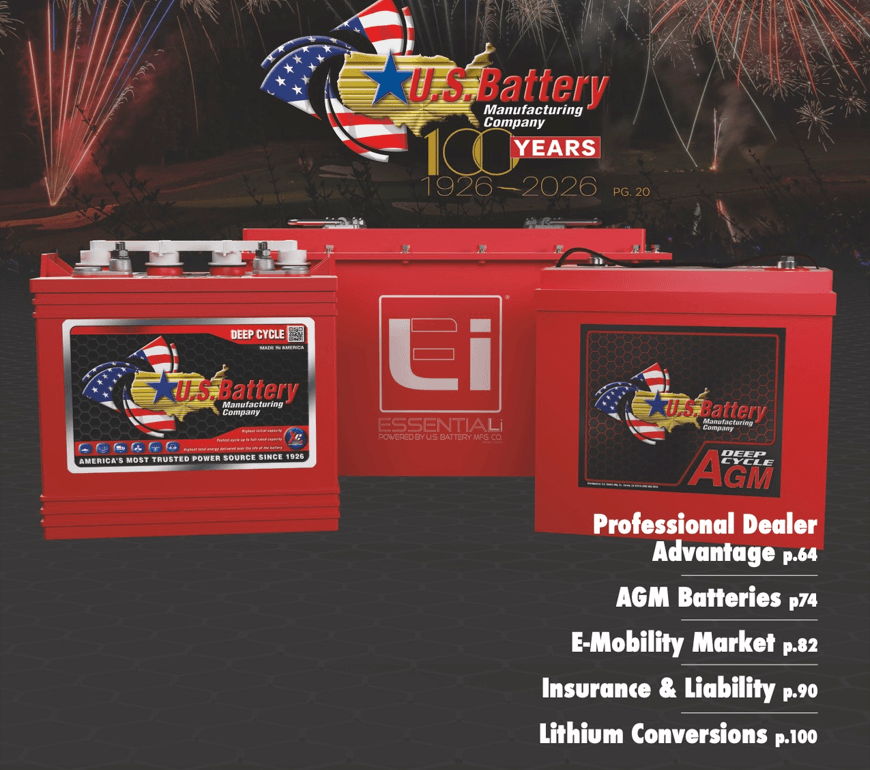
As America celebrates its 250th birthday this July 4th, American manufacturing companies stand proud to say their products are “Made In The USA.” One of them is U.S. Battery Manufacturing, which is celebrating its 100th anniversary this year.






Looking back at the history of the battery industry in the United States, the first mass-produced batteries came into use in this country around the 1890s for stationary engines, telephones and flashlights. It wasn’t until 1901 that Thomas Edison invented the alkaline storage battery in the U.S. for electric vehicles. A little more than twenty years later, U.S. Battery was founded in 1926 and was one of several battery manufacturers and assemblers located in San Diego, California.
THE MOVE TO INDUSTRIAL DEEP-CYCLE BATTERIES
A long-time industry entrepreneur, John Anderson, and his partner Cliff Richards, were in a position to acquire U.S. Battery in 1972. They relocated their operations to Signal Hill, California, where U.S. Battery was merged into their existing company, which then functioned under the name Battery Plates. At that time, Anderson knew America’s battery industry was changing and growing rapidly. To remain competitive, the company segmented into one of the various markets for Flooded Lead-Acid (FLA) batteries, focusing on manufacturing deep-cycle batteries for industrial uses.
American’s love for golfing and the electric golf car, helped bring U.S. Battery Manufacturing great success in serving this industry, as well as many others. The company’s dedicated focus on deep-cycle, Flooded Lead-Acid batteries quickly earned it worldwide recognition, especially with golf car owners and the golf car manufacturers. The number of battery products flooded the market, and like other American manufacturers, U.S. Battery began to be known for its product’s reliability and maintaining the highest quality standards.
U.S. Battery expanded its operations in 1987 with a new plant in Evans, Georgia, to reach East Coast customers and a growing worldwide customer base. With several production facilities across the country, there was a continuous need for expansion and modernization. In 1989, a new facility was built in Corona, California, which became the company’s official headquarters. At the same time, Anderson bought out his partner, Cliff Richards, and became the sole owner of U.S. Battery Manufacturing Company as it exists today.
U.S. Battery’s reputation continued to grow worldwide, requiring the building of another plant in Augusta, Georgia, in 2000. This plant would also get its own Oxide Mill built in 2008, allowing the company to create its own lead battery plates, which were higher in efficiency, offered improved cell plate structure, greater capacity, and faster charging times.
ALWAYS IMPROVING THE PRODUCT
The quest for constantly improving on battery design and performance was the main legacy Anderson left for the company, and it continues today. Over its history, U.S. Battery has explored the use of various technologies that continue to keep FLA batteries at the top of the list of golf car owners for cost-effectiveness, recyclability, and long run times. The company’s advancements in AGM deep-cycle batteries and its investment in its Essential Li® line of Lithium-ion batteries have propelled the company into the future, carrying on John Anderson’s legacy of improvement and providing customers with the best-performing battery power on the market. He believed it was essential to look for ways to improve upon the basic battery technology. U.S. Battery continues to modernize and innovate deep-cycle battery designs in multiple ways. These improvements enable the company’s products to stay ahead of the changing demands of consumers and the various industries it serves.
FLOODED LEAD-ACID BATTERY INNOVATIONS
U.S. Battery has, throughout its history, created significant advancements to deliver longer cycle life, provide more capacity, and cycle up to full-rated capacity faster than previous FLA designs.
ADVANCEMENT: LEAD GRID PLATES
Benefit: Makes golf car batteries last longer.
How: U.S. Battery found that the limits of the FLA cell design were the corrosion that occurred in the battery’s positive grid plate. The use of Selenium as an additional additive was introduced to the lead-antimony to refine the lead grains to a fine alloy. This provided greater strength and corrosion resistance over conventional lead-antimony alloys, and positive grid corrosion is no longer the primary failure mode and contributes to the improved cycle life of FLA deep-cycle batteries.
ADVANCEMENT: LEAD SULFATE CRYSTALS
Benefit: Allows golf car batteries to charge faster, quickly reach rated capacity, and have higher peak capacity for better vehicle performance.
How: Historically, positive electrodes have been processed using a procedure called hydroset, designed to ‘grow’ tetrabasic lead sulfate (TTBLS) crystals in the battery plates. U.S. battery found ways to improve the active materials on the positive plates from using a mixture of lead oxide, sulfuric acid, and various additives to increase the life of the positive electrodes. Through the use of proprietary crystal seeding additives, U.S. Battery discovered that the range of the size of crystals can be controlled to the most desirable levels. Uniformly controlling the size of the crystals in the TTBLS structure resulted in increased initial capacity, faster cycle-up to rated capacity, higher peak capacity, and improved charging using the wide range of charger technologies used in various applications.
ADVANCEMENT: ACTIVE MATERIALS
Benefit: Gives golf car batteries longer cycle-life and capacity.
How: The addition of active materials like carbon additives in the negative plates of deep-cycle batteries prevents the natural tendency of the negative active material to shrink or coalesce during cycling, which can cause active material shrinkage and reduce the capacity and life. Recent improvements in these carbon materials have opened up new opportunities to improve several performance limitations of lead-acid batteries.
ADVANCEMENT: ABSORBED GLASS MAT BATTERY INNOVATIONS
Benefit: Better all-around charging and zero maintenance
How: Improving resistance to corrosion on positive electrodes and the addition of carbon-enhanced negative active materials improved charge acceptance on AGM deep-cycle batteries. With zero maintenance, they are an excellent option for golf cars with difficult-to-access battery compartments or in applications where corrosion is a concern, such as beach communities.
ADVANCEMENT: LITHIUM-ION BATTERY INNOVATIONS
Benefit: Zero Maintenance, 100% Capacity, Safe and Ultra-Reliable
How: In 2022, U.S. Battery introduced its Essential Li® line of deep-cycle batteries, with the same commitment to delivering high-quality and reliability as it does with its FLA and AGM lines. To do this, U.S. Battery chose to use Prismatic LFP cells instead of Cylindrical cells, which are used in most Li deep-cycle golf car batteries. U.S. Battery also preferred to connect its battery cells with laser welding to provide greater shock and vibration resistance over the industry standard of spot welding.
U.S. Battery also took the step to have its Essential Li® line of batteries tested by the Underwriters’ Laboratory to receive UL 2271 certification for preventing fire or explosion, UL 2580 certification for quality and safety when used in electric vehicles, and UL 38.3 certification for safe transport in the U.S. and globally. U.S. Battery’s Essential Li® line of Li batteries is also IP67 rated for dust and moisture damage.
In 2025, U.S. Battery began integrating a heating element to its Essential Li line of batteries, enabling improved charge efficiencies in colder climates and during seasonal use.
CONTINUING THE COMMITMENT
With America and U.S. Battery celebrating milestone anniversaries this year, the company remains proud in its continued efforts to improve its product’s designs, efficiency, reliability, and maintaining the highest quality products with the golf car industry in mind. For more information, visit www.usbattery.com.