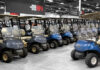










The 2026 PGA Show was significantly different from its predecessors. It was different in terms of the sheer number of golf car exhibits, the diversity of exhibitors with regard to brand and manufacturing source, as well as the tidal shift from a golf focus to street legal products and models.








The industry is now under the regime of anti-dumping penalties and the countervailing duties, as imposed by the U.S. International Trade Commission and the Department of Commerce. This accounts for at least some of the increased number of golf car exhibitors, as well as shifting supply chains. This is given more detail below.
The shift to street legal golf cars—the emerging market takes hold
Not that there were no traditional golf cars on display, but virtually all manufacturers, domestic and foreign, had street legal (low speed vehicle—LSV) models as their principal showpiece. Thus, the side rear view mirrors, the LED light kits, LCD touch screens, rear view cameras, and self-correcting turn signals have become virtually standard features.
Beyond the technology and the newly standardized upgrades are the body styling features, in particular rakish cowls adorned with eye-catching front lighting. That is now the trademark of the new vehicle look.
Another style feature seen at the Show was swept-back, full-coverage front windshields, rendering a more automotive look for the vehicle and replacing the typical, traditional look of golf cars. This feature was observed in both side-by-side seating and single-seating vehicles.
The number of LSV-equipped vehicles and the number of new brands and companies give a strong hint as to what lies ahead for the evolution of industry structure. Industry structure in terms of the number of competitors is impacted by changes in consumer tastes, new technology, and government policy. In the case of golf car-type vehicles, all three factors are in play.
In the next section, these factors are discussed in more detail, in particular to start with, the impact of government policy.
Shifting supply chains as companies react to anti-dumping penalties and countervailing duties (AD/CVD): Implications for Industry Structure and Competition
The following table represents the results of direct, in-person interviews with golf car-type vehicle manufacturers, who had, or are, importing complete units or partial assemblies from countries in Asia. It should be noted that there were other vendors present, but due simply to a lack of time, not all could be interviewed. In all likelihood, there were at least 4-8 additional companies at the Show.
As may be seen, the dispersion of factory and assembly plants—post AD/CVD penalties—is quite substantial: 4 companies moved to Cambodia, 2 to Vietnam, 1 to Thailand, and several to other locations. Of the 15 companies listed, at least 11 have either moved to the U.S., are looking for locations, or are considering the possibility of moving full assembly facilities to the U.S.
This movement and shifting of the supply chain is largely due to additional tariffs and penalties levied against China, which were alluded to above. This imposition of government policy thus will transform the manufacturing base and the competitive structure of the market in the United States:
- Far from making the industry less competitive, as most economic models would predict, the market environment will almost certainly become more competitive;
- The industry will rapidly evolve from a trilogy of dominant companies, an oligopoly, to one much closer to perfect competition;
- The result of greater competition will be lower prices, more product upgrades, and an expansion of the market, as golf car vehicles (LSVs) will become increasingly popular and a more practical choice compared to conventional automobiles and light trucks.
“The times they are a-changing indeed.”
New technologies promise greater range and less anxiety
Range anxiety bas been an on-going concern for quite some time. Two exhibitors at the Show in particular introduced new products that addresses this issue. One company was StarEV with a new permanent magnet motor, in its newest LSV model, and the second was Lani EV with a technologically advanced solar power system.
A third company, WiTricity, presented a new model of its wireless charging system, which has the potential of enhancing opportunity charging for short distance driving destinations.
StarEV introduces its permanent magnet motor
StarEV introduced a new model prototype vehicle, dubbed Gemini. Aside from a stylish look the Gemini features a permanent magnet electric motor, promising more distance and greater power.
The Gemini is feature-rich with back-up camera, adjustable steering wheel and armrests, and an attractive LED lighting package. The unit has four, front facing seating in concert with a clear trend in in golf car-type vehicle models across many brands.
The outstanding feature, however, is the permanent magnet motor. As described by Doub Ballenger, StarEV’s Executive Sales Director, the permanent magnet motor is the next iteration of electric motor engineering upgrade, just as the AC induction motor outperformed its predecessor, the DC motor, some years ago. The result is 15% more efficiency, and the vehicle has been tested for a distance of 90 miles.
In the model pictured, the seating is a traditional side-by-side, with a baggage area to the rear. While an open cockpit is shown, the cockpit can be fully enclosed with hard doors and roll-up windows. The upper body of the vehicle is constructed with door frames to accommodate secure, weather-tight doors.
The Gemini stands out as the next iteration in the development of street legal golf cars which will be fully weatherized for year around use. As Ballenger put it, “The Gemini is the SUV of golf cars.”
Lani EV with new solar power technology
In the same vein of increased efficiency and greater distance, Lani EV introduced an improved rooftop solar panel that promises greater distance per charge with a corresponding decrease in operating costs.
In the words of Jeff Watters, the Founder of Lani:
“Our LANI SOLAR roof frame encases a state-of-the-art solar panel using an ultra-lightweight aluminum perimeter frame with a patent-pending damping system designed to maintain stability and prevent vibration-related cracking.”
“It also features an integrated MPPT controller that converts the captured energy from the solar panel into either a 48V or 72V power flow directly feeding the batteries in our LANI EV golf cars and ZROX LSVs.” (See the ZROX pictured on previous page.)
Jeff Watters adds, “The construction is engineered to reduce weight, maximize durability and improve heat dissipation, providing the consistent state-of-charge advantages we discussed.”
The combination of solar panel energy and integrated controller and battery management system, results in the Lani golf car returning to the charging facility after 18 holes of golf still fully charged. Depending on terrain and available sunlight, Watters states that fully charged capacity could be achieved for two 18-hole rounds.
A similar system could be installed for the company’s ZROX LSV, thus enhancing the prospects for developing the short distance driving market.
WiTricity produces wireless charging systems for a variety of electric powered vehicles, from airport tugs to golf cars. The company has two systems within the category of 1 Kw and lower, one, a 900 Watt model for light duty commercial vehicles, and the other, a 600 Watt model for golf car-type vehicles, particularly LSVs.
Columbia Vehicle Group’s new Venture
The Columbia Vehicle Group, comprised of Columbia and Tomberlin launched a new line of utility vehicles at the Show, called Venture. The key models on display were the Venture 2XL and the Venture 6X.
The Venture 6X measures 153”L X63”W X 76”H and comes with a 30 hp permanent magnet electric motor. The cab is fully enclosed and weatherized. It is a large vehicle engineered for 900 lbs. of load capacity and a towing capacity of over 1,100 pounds.
The vehicle comes with a 19 Kw lithium ion battery, including a thermal management system.
By comparison, the 2XL model is smaller, but has virtually all the features of its larger cousin, including a back-up camera, LED lighting package, power steering, and is also fully enclosed.
These models may make headway in the last-mile delivery market because of their size, versatility, and power.
The 2026 PGA Show was a show-stopper
Hopefully, the above article indicates the depth and size of the vehicle exhibits, as well as the changes in industry structure that are clearly at hand. Golf car-type vehicles, given the variety and number of brands on display, are poised for significant changes in market structure and expansion, fueled by a highly competitive market environment. Also, look for intensive activity in product diversity and upgrades over the next 3-5 years.